Categorization of patients according to risk and dependency by nurses, Pediatric Intensive Care Unit, Dr. Ovidio Aliaga Uría Children's Hospital
DOI:
https://doi.org/10.35319/conr.20257111Keywords:
Classification-sizing, patient categories, nursing systematization toolsAbstract
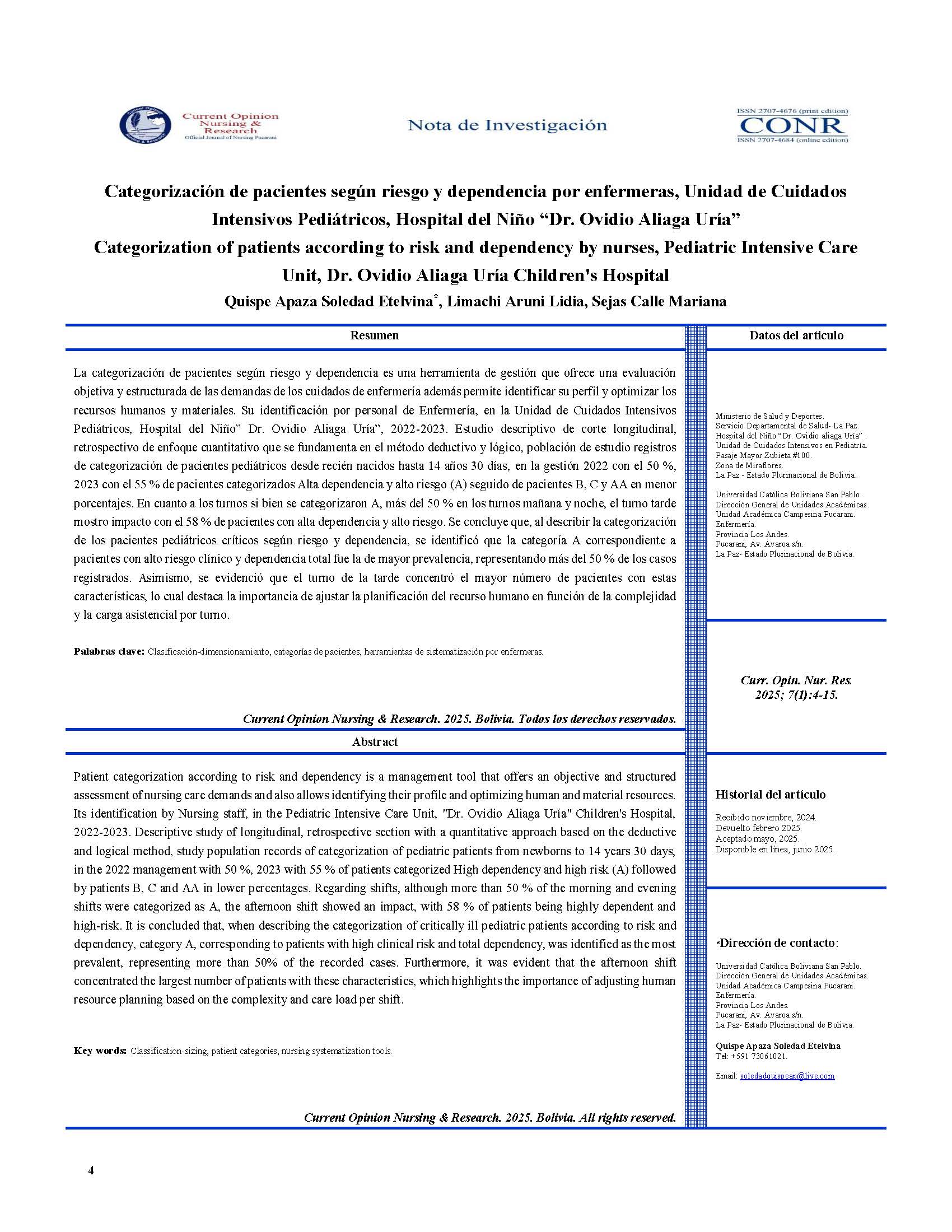
Patient categorization according to risk and dependency is a management tool that offers an objective and structured assessment of nursing care demands and also allows identifying their profile and optimizing human and material resources. Its identification by Nursing staff, in the Pediatric Intensive Care Unit, "Dr. Ovidio Aliaga Uría" Children's Hospital, 2022-2023. Descriptive study of longitudinal, retrospective section with a quantitative approach based on the deductive and logical method, study population records of categorization of pediatric patients from newborns to 14 years 30 days, in the 2022 management with 50 %, 2023 with 55 % of patients categorized High dependency and high risk (A) followed by patients B, C and AA in lower percentages. Regarding shifts, although more than 50 % of the morning and evening shifts were categorized as A, the afternoon shift showed an impact, with 58 % of patients being highly dependent and high-risk. It is concluded that, when describing the categorization of critically ill pediatric patients according to risk and dependency, category A, corresponding to patients with high clinical risk and total dependency, was identified as the most prevalent, representing more than 50% of the recorded cases. Furthermore, it was evident that the afternoon shift concentrated the largest number of patients with these characteristics, which highlights the importance of adjusting human resource planning based on the complexity and care load per shift.
Downloads
References
Bruzzone Filgueira PR, Ochoa Quiñones GP. Categorización usuaria por riesgo y dependencia, ¿utilidad o rutina? Percepción de enfermería [tesis licenciatura]. [Valdivia]: Universidad Austral de Chile; 2010 [citado 26 de octubre de 2023]. Recuperado a partir de: http://cybertesis.uach.cl/tesis/uach/2010/fmb914c/doc/fmb914c.pdf
Nogueira LDS, Santos RM, Mataloun SE, Moock M. Nursing activities score: comparação com o Índice APACHE II e a mortalidade em pacientes admitidos em unidade de terapia intensiva. Rev Bras Ter Intensiva 2007;19(3):327-30. DOI: https://doi.org/10.1590/S0103-507X2007000300010
Knaus WA, Draper EA, Wagner DP, Zimmerman JE. APACHE II: a severity of disease classifica-tion system. Crit Care Med 1985;13(10):818-29. DOI: https://doi.org/10.1097/00003465-198603000-00013
Knaus WA, Wagner DP, Draper EA, Zimmerman JE, Bergner M, Bastos PG, et al. The APACHE III prognostic system. Risk prediction of hospital mortality for critically ill hospitalized adults. Chest 1991;100(6):1619-36. DOI: https://doi.org/10.1378/chest.100.6.1619
Vincent JL, Moreno R, Takala J, Willatts S, De Mendonça A, Bruining H, et al. The SOFA (Sepsis-related Organ Failure Assessment) score to describe organ dysfunction/failure. On behalf of the Working Group on Sepsis-Related Problems of the European Society of Intensive Care Medicine. Intensive Care Med 1996;22(7):707-10. DOI: https://doi.org/10.1007/BF01709751
Berbiglia VA, Banfield B. Self-care deficit theory of nursing. In: Alligood MR. Nursing theorists and their work. [Internet]. St. Louis Missouri: Else-vier; 2018. p. 198-291. Retrieved from: https://www.google.co.in/books/edition/_/l7stDwAAQBAJ?hl=en&gbpv=0
Cullen DJ, Civetta JM, Briggs BA, Ferrara LCl. Therapeutic intervention scoring system: a me-thod for quantitative comparison of patient care. Crit Care Med 1974;2(2):57-60.
Miranda DR, de Rijk A, Schaufeli W. Simplified therapeutic intervention scoring system: the TISS-28 items-results from a multicenter study. Crit Care Med 1996;24(1):64-73. DOI: https://doi.org/10.1097/00003246-199601000-00012
Miranda DR, Nap R, de Rijk A, Schaufeli W, Iapichino G, Members of the TISS Working Group. Nursing activities score. Crit Care Med 2003;31(2):374-82. DOI: https://doi.org/10.1097/01.CCM.0000045567.78801.CC
García MA, Castillo FL, Categorización de usua-rios: una herramienta para evaluar las cargas de trabajo de enfermería. Rev Méd Chile 2000;128 (2):177-83. DOI: http://dx.doi.org/10.4067/S0034-98872000000200007
Miranda LR, Contreras SV, Bango VNL, Bonilla LC. Efectos de la asignación enfermera-paciente a través de la evaluación clínica (TISS-28). Rev Enferm IMSS 2002;10(2):73-8.
Vega-Angarita OM, Gonzalez-Escobar DS. Teo-ría del déficit de autocuidado: interpretación desde los elementos conceptuales. Rev Cienc Cuidad 2007;4(1):28-35. DOI: https://doi.org/10.22463/17949831.919
Sieben-Hein D, Steinmiller EA. Working with complex care patients. J Pediatr Nurs 2005;20(5): 389-95. DOI: https://doi.org/10.1016/j.pedn.2005.06.011
Hutchfield K. Family-centred care: a concept analysis. J Adv Nurs 1999;29(5):1178-87. DOI: https://doi.org/10.1046/j.1365-2648.1999.00987.x
Pinto JP, Ribeiro CA, Pettengill MM, Balieiro MMF. Cuidado centrado na família e sua aplica-ção na enfermagem pediátrica. Rev Bras Enferm 2010;63(1):132-5. DOI: https://doi.org/10.1590/S 0034-71672010000100022
Dini AP, Fugulin FM, Veríssimo M de L, Guirardello Ede B. Pediatric Patient Classification System: construction and validation of care categories. Rev Esc Enferm USP 2011;45(3):575-80. DOI: https://doi.org/10.1590/s0080-62342011000300004
Romero-Massa E, Lorduy-Bolívar JP, Pájaro-Melgar C, Pérez-Duque CA. Relación entre la carga laboral de enfermería y la gravedad del paciente en unidades de cuidado intensivo de adultos. Aquichan 2011;11(2):173-86.
Guardalupe JA, Brum ID, Canto DFD, Telles KCM, Magalhães AMM, Oliveira JLC. Compari-son of patient classification systems for dimen-sionning nursing staff. Rev Esc Enferm USP 2023;57:e20230047. DOI: https://doi.org/10.1590/1980-220X-REEUSP-2023-0047en
Moraes RMR, Lara ACD, Remedio EC, Gaiva MAM, Gentilini MM, Oliveira JLCD, Magalhaes AMM. Clasificación de pacientes y dimensiona-miento del personal de enfermería en una unidad de hospitalización pediátrica. Cogitare Enferm 2023;28:e83871. DOI: https://doi.org/10.1590/ce.v28i0.89206
Perroca MG. Desarrollo y validación de contenido de la nueva versión de un instrumento para clasifi-cación de pacientes. Rev Latino-Am Enfermagem 2011;19(1):58-66. DOI: https://doi.org/10.1590/S0104-11692011000100009
Perroca MR. Sistema de classificação de pacientes: construção e validação de um instru-mento. Rev Esc Enf USP 1998;32(2):153-68. DOI: https://doi.org/10.1590/S0080-62341998000200009
Gonzalez P, Kappes MS, Gallardo Vargas C. Cuidados según dependencia y riesgo en hospi-tales de baja complejidad del Servicio de Salud Reloncavi, Chile. Cienc Enferm 2024;30:31. DOI: https://doi.org/10.29393/CE30-31CSPC30031
Al-Dweik G, Ahmad M. Matching nursing assign-ment to patients' acuity level: the road to nurses' satisfaction. J Nurs Meas 2019;27(1):E34-47. DOI: https://doi.org/10.1891/1061-3749.27.1.E34
Almagro P, Ponce A, Komal S, de la Asunción Villaverde M, Castrillo C, Grau G, et al. Multi-morbidity gender patterns in hospitalized elderly patients. PLoS One 2020;15(1):e0227252. DOI: https://doi.org/10.1371/journal.pone.0227252
Downloads
Published
How to Cite
Issue
Section
License
Copyright (c) 2026 Current Opinion Nursing & Research

This work is licensed under a Creative Commons Attribution-NonCommercial 4.0 International License.