Impacto del Síndrome de Burnout: Análisis de factores condicionantes y prevalencia en el personal de enfermería del Hospital Municipal de Caranavi, 2022
DOI:
https://doi.org/10.35319/conr.2025726Palabras clave:
Síndrome de Burnout, agotamiento emocional, despersonalización, realización personal, afectación, multifactorialResumen
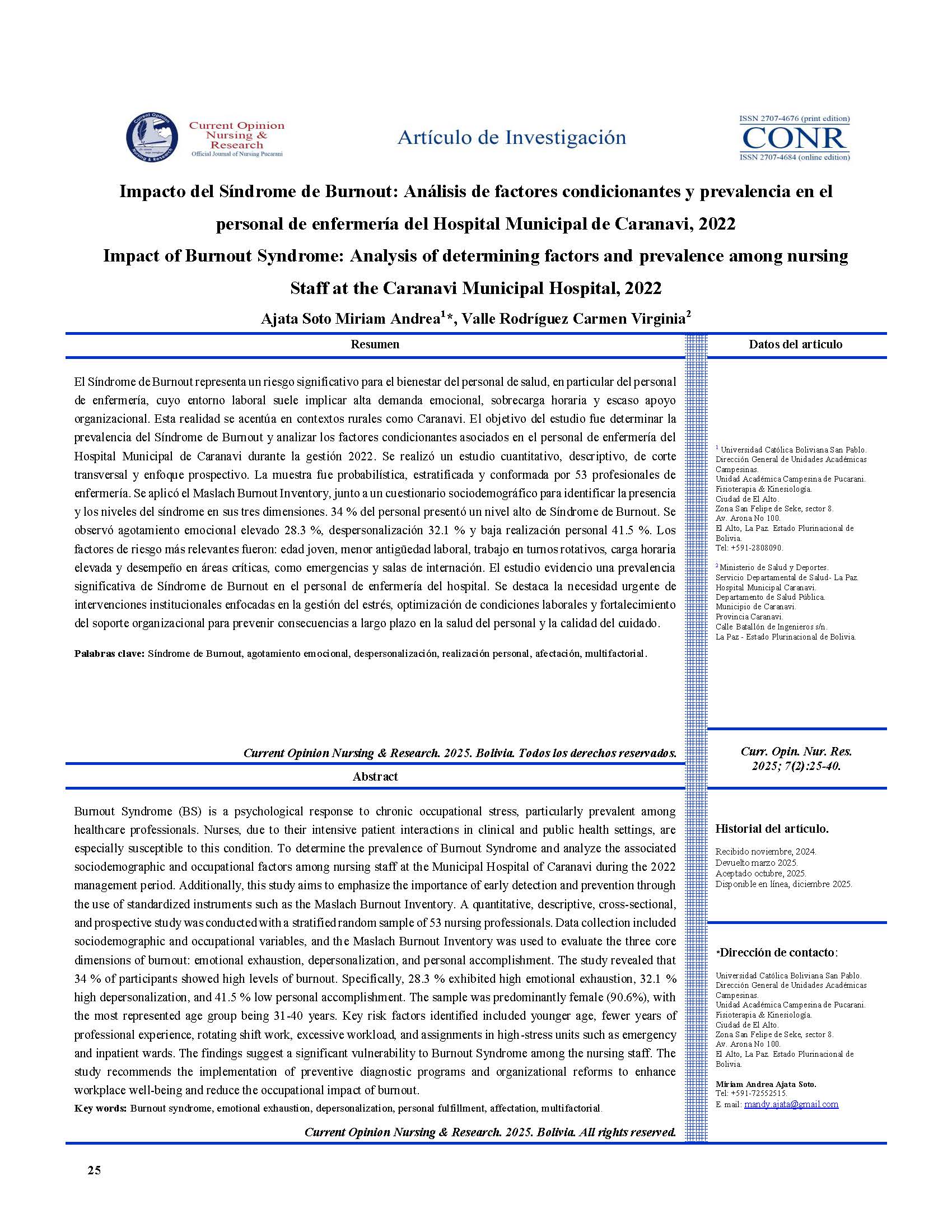
El Síndrome de Burnout representa un riesgo significativo para el bienestar del personal de salud, en particular del personal de enfermería, cuyo entorno laboral suele implicar alta demanda emocional, sobrecarga horaria y escaso apoyo organizacional. Esta realidad se acentúa en contextos rurales como Caranavi. El objetivo del estudio fue determinar la prevalencia del Síndrome de Burnout y analizar los factores condicionantes asociados en el personal de enfermería del Hospital Municipal de Caranavi durante la gestión 2022. Se realizó un estudio cuantitativo, descriptivo, de corte transversal y enfoque prospectivo. La muestra fue probabilística, estratificada y conformada por 53 profesionales de enfermería. Se aplicó el Maslach Burnout Inventory, junto a un cuestionario sociodemográfico para identificar la presencia y los niveles del síndrome en sus tres dimensiones. 34 % del personal presentó un nivel alto de Síndrome de Burnout. Se observó agotamiento emocional elevado 28.3 %, despersonalización 32.1 % y baja realización personal 41.5 %. Los factores de riesgo más relevantes fueron: edad joven, menor antigüedad laboral, trabajo en turnos rotativos, carga horaria elevada y desempeño en áreas críticas, como emergencias y salas de internación. El estudio evidencio una prevalencia significativa de Síndrome de Burnout en el personal de enfermería del hospital. Se destaca la necesidad urgente de intervenciones institucionales enfocadas en la gestión del estrés, optimización de condiciones laborales y fortalecimiento del soporte organizacional para prevenir consecuencias a largo plazo en la salud del personal y la calidad del cuidado.
Descargas
Citas
Krueger RB, Reed GM, First MB, Marais A, Kismodi E, Briken P. Proposals for paraphilic disorders in the international classification of diseases and related health problems, eleventh revision (ICD-11). Arch Sex Behav 2017;46(5): 1529-45. DOI: https://doi.org/10.1007/s10508-017-0944-2
Ge MW, Hu FH, Jia YJ, Tang W, Zhang WQ, Chen HL. Global prevalence of nursing burnout syndrome and temporal trends for the last 10 years: A meta-analysis of 94 studies covering over 30 countries. J Clin Nurs 2023;32(17-18): 5836-54. DOI: https://doi.org/10.1111/jocn.16708
Amiri S, Mahmood N, Mustafa H, Javaid SF, Khan MA. Occupational risk factors for burnout syndrome among healthcare professionals: a glo-bal systematic review and meta-analysis. Int J Environ Res Public Health 2024;21(12):1583. DOI: https://doi.org/10.3390/ijerph21121583
Mohr DC, Elnahal S, Marks ML, Derickson R, Osatuke K. Burnout trends among US health care workers. JAMA Netw Open 2025;8(4):e255954. DOI: https://doi.org/10.1001/jamanetworkopen.2025.5954
Youssef D, Abboud E, Abou-Abbas L, Hassan H, Youssef J. Prevalence and correlates of burnout among Lebanese health care workers during the COVID-19 pandemic: a national cross-sectional survey. J Pharm Policy Pract 2022;15(1):102. DOI: https://doi.org/10.1186/s40545-022-00503-2
Linzer M, Jin JO, Shah P, Stillman M, Brown R, Poplau S, et al. Trends in clinician burnout with associated mitigating and aggravating factors during the COVID-19 Pandemic. JAMA Health Forum 2022; 3(11): e224163. DOI: https://doi.org/10.1001/jamahealthforum.2022.4163. Erra-tum in: JAMA Health Forum. 2023;4(2): e230002. DOI: https://doi.org/10.1001/jamahealth forum.2023.0002
Grigorescu S, Cazan AM, Rogozea L, Grigorescu DO. Predictive factors of the burnout syndrome occurrence in the healthcare workers during the COVID-19 Pandemic. Front Med (Lausanne) 2022;9:842457. DOI: https://doi.org/10.3389/fmed.2022.842457
Purwandari R, Ardiana A, Afandi AT, Kurniawan DE. Burnout syndrome among COVID-19 vaccinators. Int J Publ Health Sci 2023;12(4): 1548-54. DOI: https://doi.org/10.11591/ijphs.v124.22851
Fattahi R, Attiya N, Bensouda Korachi I, Filali-Zegzouti A, El Haidani A, Boutahricht M, et al. Prevalence and risk factors of burnout syndrome among public health personnel in the Errachidia Province (Morocco). Work 2025;80(3):1244-53. DOI: https://doi.org/10.1177/10519815241289771
Konlan KD, Asampong E, Dako-Gyeke P, Glozah FN. Burnout syndrome among healthcare workers during COVID-19 Pandemic in Accra, Ghana. PLoS One 2022;17(6):e0268404. DOI: https://doi.org/10.1371/journal.pone.0268404
Scheepers R, Silkens M, van den Berg J, Lombarts K. Associations between job demands, job resources and patient-related burnout among physicians: results from a multicentre observa-tional study. BMJ Open 2020;10(9):e038466. DOI: https://doi.org/10.1136/bmjopen-2020-038466
Borges EMDN, Queirós CML, Abreu MDSN, Mosteiro-Diaz MP, Baldonedo-Mosteiro M, Baptista PCP, et al. Burnout among nurses: a multicentric comparative study. Rev Lat Am Enfermagem 2021;29:e3432. DOI: https://doi.org/10.1590/1518-8345.4320.3432
Ballester Arnal R, Gómez Martínez S, Gil Juliá B, Ferrándiz-Sellés MD, Collado-Boira EJ. Burnout y factores estresantes en profesionales sanitarios de las unidades de cuidados intensivos. Rev Psicopatol Psicol Clin 2016;21(2):129-36. DOI: https://doi.org/10.5944/rppc.vol.21.num.2.2016.16146
Galanis P, Vraka I, Fragkou D, Bilali A, Kaitelidou D. Nurses' burnout and associated risk factors during the COVID-19 pandemic: A systematic review and meta-analysis. J Adv Nurs 2021;77(8):3286-302. DOI: https://doi.org/10.1111/jan.14839
Torre M, Santos Popper MC, Bergesio A. Burnout prevalence in intensive care nurses in Argentina. Enferm Intensiva (Engl Ed) 2019;30(3):108-15. DOI: https://doi.org/10.1016/j.enfi.2018.04.005
Li LZ, Yang P, Singer SJ, Pfeffer J, Mathur MB, Shanafelt T. Nurse burnout and patient safety, satisfaction, and quality of care: a systematic review and meta-analysis. JAMA Netw Open 2024;7(11):e2443059. DOI: https://doi.org/10.1001/jamanetworkopen.2024.43059
Gómez-Urquiza JL, Vargas C, De la Fuente EI, Fernández-Castillo R, Cañadas-De la Fuente GA. Age as a risk factor for burnout syndrome in nursing professionals: a meta-analytic study. Res Nurs Health 2017;40(2):99-110. DOI: https://doi.org/10.1002/nur.21774
Putra KR. Prevalence of burnout syndrome among nurses in general hospitals in provincial East Java: Cross-sectional study. Enferm Clin 2019;29 Suppl 2:362-6. DOI: https://doi.org/10.1016/j.enfcli.2019.04.045
Zhou LL, Zhang SE, Liu J, Wang HN, Liu L, Zhou JJ, et al. Demographic factors and job charac-teristics associated with burnout in chinese female nurses during controlled COVID-19 period: a cross-sectional study. Front Public Health 2022; 9:757113. DOI: https://doi.org/10.3389/fpubh.2021.757113
Salcedo-Vite DA, Morales-Fonseca CF, Jurado-Mendoza DE, Romero-Vega JV. Factores sociodemográficos asociados al Síndrome de Burnout en profesionales de enfermería. Rev Arbitr Interdiscip Cienc Salud 2022;6(1):780-9. DOI: http://dx.doi.org/10.35381/s.v.v6i1.2144
Poghosyan L, Aiken LH, Sloane DM. Factor structure of the Maslach burnout inventory: an analysis of data from large scale cross-sectional surveys of nurses from eight countries. Int J Nurs Stud 2009; 46(7): 894-902. DOI: https://doi.org/10.1016/j.ijnurstu.2009.03.004. Erratum in: Int J Nurs Stud. 2014;51(10):1416-7.
Lin CY, Alimoradi Z, Griffiths MD, Pakpour AH. Psychometric properties of the Maslach Burnout Inventory for Medical Personnel (MBI-HSS-MP). Heliyon 2022;8(2):e08868. DOI: https://doi.org/10.1016/j.heliyon.2022.e08868
Narváez Angulo SL, Vides Miranda HF, Ballesteros Rojas PL. Prevalencia del burnout académico en estudiantes de medicina y su implicancia para la creación de un centro de apoyo psicológico. Criterio 2025;5(9):26-35. DOI: https://doi.org/10.62319/criterio.v.5i9.45
World Medical Association. World Medical Association Declaration of Helsinki: ethical principles for medical research involving human subjects. JAMA 2013;310(20):2191-4. DOI: https://doi.org/10.1001/jama.2013.281053
Efa AG, Lombebo AA, Nuriye S, Facha W. Prevalence of burnout and associated factors among nurses working in public hospitals, southern Ethiopia: a multi-center embedded mixed study. Sci Rep 2024;14:31268. DOI: https://doi.org/10.1038/s41598-024-82703-1
Gambaro E, Gramaglia C, Marangon D, Probo M, Rudoni M, Zeppegno P. Health workers' burnout and covid-19 pandemic: 1-year after-results from a repeated cross-sectional survey. Int J Environ Res Public Health 2023;20(12):6087. DOI: https://doi.org/10.3390/ijerph20126087
Rosales-Cortés C, Contreras-Sepúlveda F, Oliva-Moresco P. Síndrome de Burnout y su relación con variables sociodemográficas y laborales de trabajadores del Cesfam de Ñipas. Rev Chil Salud pública 2024;28:e72874. DOI: https://doi.org/10.5354/0719-5281.2024.72874
Valdes-Elizondo GD, Álvarez-Maldonado P, Ocampo-Ocampo MA, Hernández-Ríos G, Réding-Bernal A, Hernández-Solís A. Burnout symptoms among physicians and nurses before, during and after COVID-19 care. Rev Lat Am Enfermagem 2023;31:e4046. DOI: https://doi.org/10.1590/1518-8345.6820.4046
Wudarczyk B, Krupa-Nurcek S, Czapla M, Uchmanowicz I. Factors influencing burnout, stress levels, and coping strategies among nursing staff in intensive care units. Front Public Health 2025;13:1530353. DOI: https://doi.org/10.3389/fpubh.2025.1530353
Getie A, Ayenew T, Amlak BT, Gedfew M, Edmealem A, Kebede WM. Global prevalence and contributing factors of nurse burnout: an umbrella review of systematic review and meta-analysis. BMC Nurs 2025;24(1):596. DOI: https://doi.org/10.1186/s12912-025-03266-8
Bizuneh B, Markos Woldesemayat E, Lucero DE, Markos T, Getachew H. Prevalence and associated factors of burnout syndrome among selected health care professionals at University Hospitals of Sidama Region and Southern, Ethiopia 2023. BMC Health Serv Res 2025;25(1):327. DOI: https://doi.org/10.1186/s12913-025-12437-x
Mfuru GH, Ubuguyu O, Yahya-Malima KI. Prevalence and factors associated with burnout among healthcare providers at Kasulu district in Kigoma region, 2024: an analytical cross-sectional study in a primary healthcare setting. BMJ Open 2024;14(12):e094520. DOI: https://doi.org/10.1136/bmjopen-2024-094520
Moya-Salazar J, Buitrón LA, Goicochea EA, Salazar CR, Moya-Salazar B, Contreras-Pulache H. The age of young nurses is a predictor of burnout syndrome during the care of patients with COVID-19. Nurs Rep 2023;13(2):721-30. DOI: https://doi.org/10.3390/nursrep13020063
Botiakova VV. Prevalence of burnout syndrome in healthcare workers in North and South America, and Asia from 2018 to 2022. Art med 2023;6(22):205-13. DOI: https://doi.org/10.21802/artm.2023.2.26.205
Merces MCD, Coelho JMF, Lua I, Silva DSE, Gomes AMT, Erdmann AL, et al. Prevalence and factors associated with burnout syndrome among primary health care nursing professionals: a cross-sectional study. Int J Environ Res Public Health 2020;17(2):474. DOI: https://doi.org/10.3390/ijerph17020474
Andra JV, Silveira CA, Terra FDS. La cronicidad y su impacto en la salud de los trabajadores: un llamado a acciones concretas. Rev Bras Enferm 2023;76(Suppl 3):e202376suppl301. DOI: https://doi.org/10.1590/0034-7167.202376suppl301es
Descargas
Publicado
Cómo citar
Número
Sección
Licencia
Derechos de autor 2026 Current Opinion Nursing & Research

Esta obra está bajo una licencia internacional Creative Commons Atribución-NoComercial 4.0.