Post-traumatic growth during the COVID-19 pandemic
Abstract
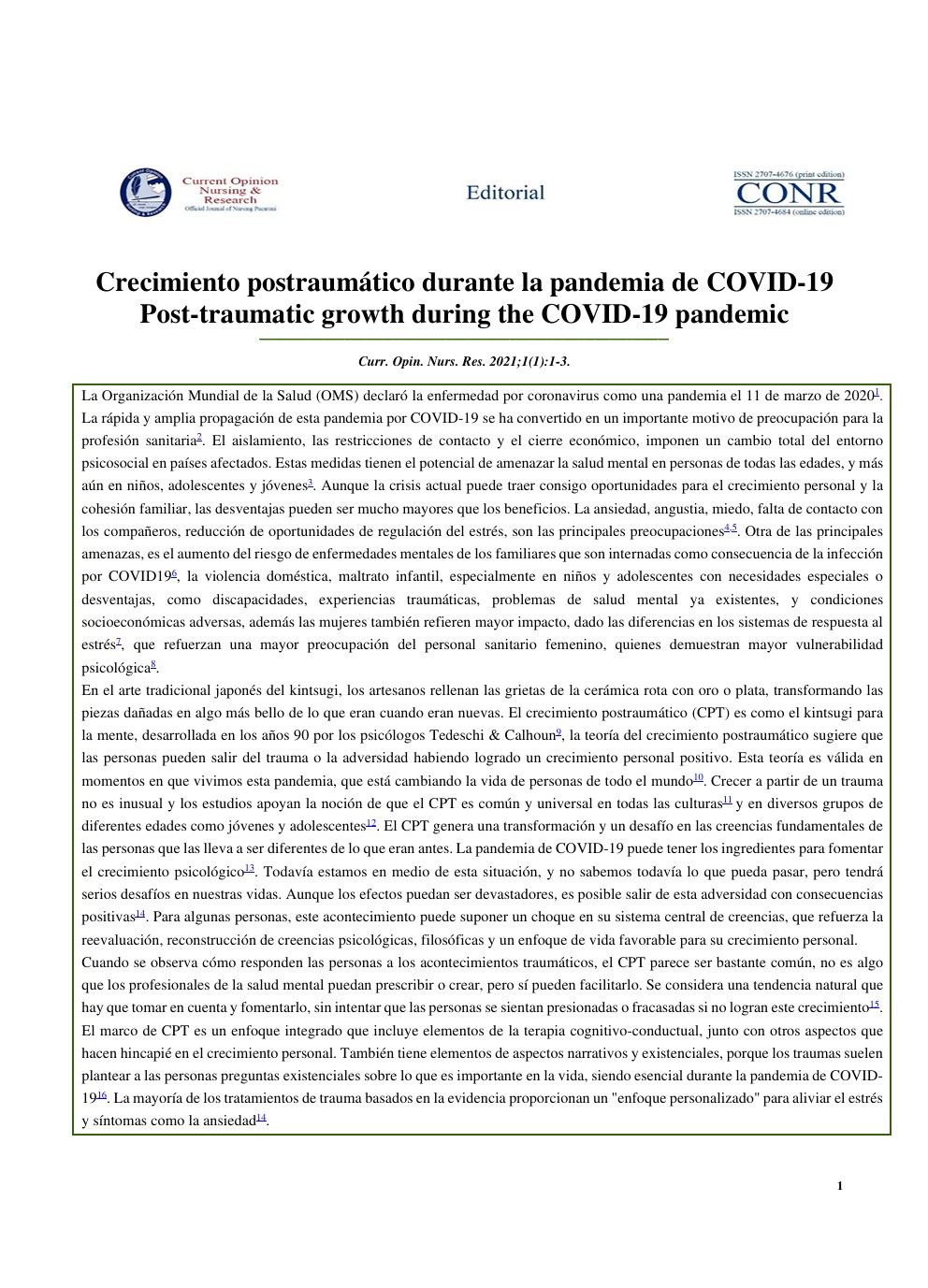
The World Health Organization (WHO) declared the coronavirus disease a pandemic on March 11, 2020. The rapid and widespread transmission of COVID-19 has become a major concern for the healthcare profession. Isolation, contact restrictions, and economic shutdowns have imposed a complete change on the psychosocial environment in affected countries. These measures have the potential to threaten the mental health of people of all ages, and even more so of children, adolescents, and young adults. Although the current crisis may bring opportunities for personal growth and family cohesion, the disadvantages may far outweigh the benefits. Anxiety, distress, fear, lack of contact with peers, and reduced opportunities for stress regulation are the main concerns. Another major threat is the increased risk of mental illness among family members hospitalized as a result of COVID-19 infection, domestic violence, and child abuse, especially in children and adolescents with special needs or disadvantages, such as disabilities, traumatic experiences, pre-existing mental health problems, and adverse socioeconomic conditions. Women also report a greater impact, given the differences in stress response systems, which reinforces a greater concern among female staff, who demonstrate greater psychological vulnerability.
Downloads
References
Coronavirus disease (COVID-19) pandemic. [Internet]. Geneva: World Health Organization (Switzerland); 2020 [citado 10 de octubre de 2016]. [cited 2020 mar 10]. Aviable from: https://www.who.int/dg/speeches/detail/who-director-general-2
Huang L, Lei W, Xu F, Liu H, Yu L. Emotional responses and coping strategies in nurses and nursing students during Covid-19 outbreak: A comparative study. PLoS One 2020;15(8):e0237303. DOI: https://doi.org/10.1371/journal.pone.0237303
Ramos-Vera CA. El trastorno de estrés postraumático en la infancia y adolescencia ante la pandemia de COVID-19. Rev Cubana Pediatr 2021;93(3):e1511.
Ayandele O, Ramos-Vera CA, Iorfa SK, Chovwen CO, Olapegba PO. Exploring the complex pathways between the fear of COVID-19 and preventive health behavior among Nigerians: Mediation and moderation analyses. Am J Trop Med Hyg 2021: tpmd200994. DOI: https://doi.org/10.4269/ajtmh.20-0994
Ramos-Vera CA. Red de síntomas psicopatológicos de la conducta alimentaria, depresión, ansiedad y estrés postraumático en adultos peruanos en cuarentena por COVID-19. Rev Cuba Enferm 2021;36:e4200.
Ramos-Vera C. Las redes de relación estadística en la investigación psiquiátrica: el caso del delirio en el contexto de COVID-19. Rev Colomb Psiquiatr 2021. DOI: https://doi.org/10.1016/j.rcp.2021.02.004
Hodes GE, Epperson CN. Sex differences in vulnerability and resilience to stress across the life span. Biol Psychiatry 2019;86(6):421-32. https://doi.org/10.1016/j.biopsych.2019.04.028
Pappa S, Ntella V, Giannakas T, Giannakoulis VG, Papoutsi E, Katsaounou P. Prevalence of depression, anxiety, and insomnia among healthcare workers during the COVID-19 pandemic: A systematic review and meta-analysis. Brain Behav Immun 2020;88:901-7. DOI: https://doi.org/10.1016/j.bbi.2020.05.026
Tedeschi RG, Calhoun LG. The Posttraumatic growth inventory: measuring the positive legacy of trauma. J Trauma Stress 1996;9(3):455-71. DOI: https://doi.org/10.1007/BF02103658
Hamam AA, Milo S, Mor I, Shaked E, Eliav AS, Lahav Y. Peritraumatic reactions during the COVID-19 pandemic - The contribution of posttraumatic growth attributed to prior trauma. J Psychiatr Res 2021;132:23-31. DOI: https://doi.org/10.1016/j.jpsychires.2020.09.029
Taku K, Tedeschi RG, Shakespeare-Finch J, Krosch D, David G, Kehl D, et al. Posttraumatic growth (PTG) and posttraumatic depreciation (PTD) across ten countries: Global validation of the PTG-PTD theoretical model. Pers Individ Dif 2021;169:e110222. https://doi.org/10.1016/j.paid.2020.110222
Ramos-Vera CA, Ramírez YB, Rojas EE, Serpa-Barrientos A, García FE. Evidencias psicométricas mediante SEM y análisis de red del inventario de crecimiento postraumático en adolescentes peruanos. Psicol Conduct 2021;29(2):XX-XX. DOI: https://doi.org/10.13140/RG.2.2.28892.72323
Lancaster SL, Klein KR, Nadia C, Szabo L, Mogerman B. An integrated model of posttraumatic stress and growth. J Trauma Dissociation 2015;16(4):399-418. DOI: https://doi.org/10.1080/15299732.2015.1009225
Jayawickreme E, Infurna FJ, Alajak K, Blackie LER, Chopik WJ, Chung JM, et al. Post-traumatic as growth as positive personality change: Challenges, opportunities, and recommendations. J Pers 2021;89(1):145-65. DOI: https://doi.org/10.1111/jopy.12591
Borghi L, Menichetti J. Strategies to cope with the COVID-related deaths among family members. Front Psychiatry 2021;12:622850. DOI: https://doi.org/10.3389/fpsyt.2021.622850
Prieto-Ursúa M, Jódar R. Finding meaning in hell. The role of meaning, religiosity and spirituality in posttraumatic growth during the coronavirus crisis in Spain. Front Psychol 2020;11:567836. DOI: https://doi.org/10.3389/fpsyg.2020.567836
Ramos-Vera CA. Conceptos de interés en la atención integral de los pacientes con multimorbilidad. Aten Primaria 2021;53(6):101969. DOI: https://doi.org/10.1016/j.aprim.2021.101969
Olson K, Shanafelt T, Southwick S. Pandemic-Driven posttraumatic growth for organizations and individuals. JAMA. 2020;324(18):1829-30. DOI: https://doi.org/10.1001/jama.2020.20275
Downloads
Published
How to Cite
Issue
Section
License
Copyright (c) 2026 Current Opinion Nursing & Research

This work is licensed under a Creative Commons Attribution-NonCommercial 4.0 International License.