Prevalence of hydatidosis in children and adolescents admitted to the children's hospital, La Paz – Bolivia, period 2015 to 2017
DOI:
https://doi.org/10.35319/conr.2019112Keywords:
Prevalence, hydatidosis, children, adolescentsAbstract
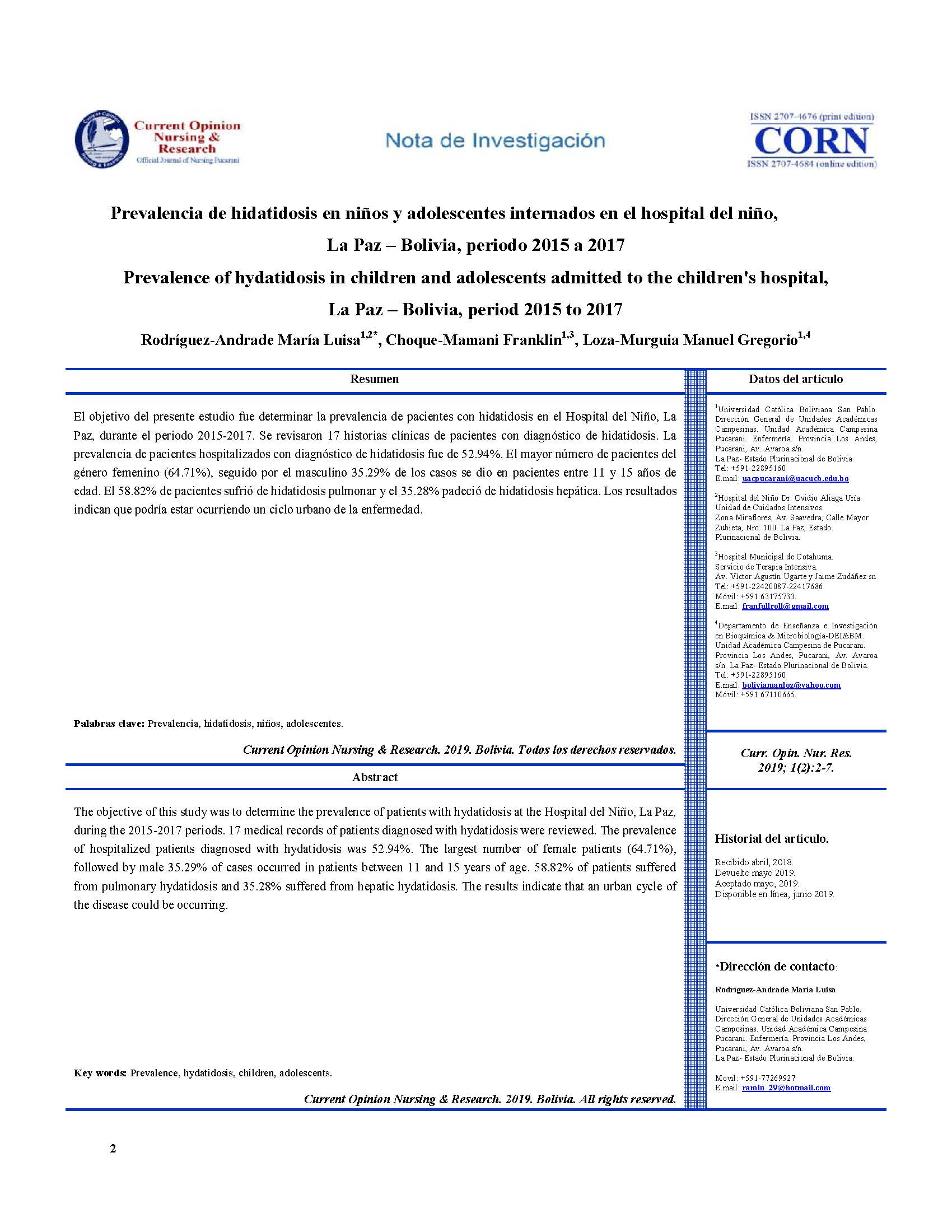
The objective of this study was to determine the prevalence of patients with hydatidosis at the Hospital del Niño, La Paz, during the 2015-2017 periods. 17 medical records of patients diagnosed with hydatidosis were reviewed. The prevalence of hospitalized patients diagnosed with hydatidosis was 52.94%. The largest number of female patients (64.71%), followed by male 35.29% of cases occurred in patients between 11 and 15 years of age. 58.82% of patients suffered from pulmonary hydatidosis and 35.28% suffered from hepatic hydatidosis. The results indicate that an urban cycle of the disease could be occurring.
Downloads
References
Chuquisana J, Chávez A, Casas E. Determi nación de Echinococcus granulosus en perros del cono Norte de Lima. Rev Inv Vet Perú 2000;11(2):24-9. doi:10.15381/rivep. v11i2.7055
Núñez E, Calero D, Estares L, Morales A. Prevalencia y factores de riesgo de hidatidosis en población general del distrito de Ninacaca-Pasco, Perú 2001. An Fac Med 2003;64(1):34-42. doi: 10.15381/anales.v6 i.1419
Legua P. Infecciones parasitarias del hígado. Rev Gastr Perú 1997;17Suppl 1:S115-27.
Larrieu E, Frider B. Human cystic echinococcosis: contributions to the natural history of the disease. Ann Trop Med Parasitol 2001:95(7):679-87. doi: 10.1080/ 0003 4980120094730
Barrios García GA, Espinoza Morales MX, Vedia Rodríguez J, Rada Álvarez J, Angles Riveros R, Tarqui Pérez HR et al. Guía técnica de vigilancia epidemiológica, prevención y control de fasciolosis e hidatidosis Serie: Documento Técnico-Normativo La Paz-Bolivia 2012 [Internet]. La Paz: Ministerio de Salud y Deportes, Programa Nacioal de Zoonosis-Unidad de Epidemiología; 2012 [citado 26 de octubre de 2016]. Publicacion No.: 270. Recuperado a partir de: https://www.minsalud.gob.bo/38-libros-y-normas/fichas-bibliograficas/1573-area-zoonosis
Stiglich M, Vega Briceño L, Gutierrez M, Trefogli P, Chiarella P. Hidatidosis pulmonar pediátrica: Reporte de 12 años de experiencia. Rev Chil Pediatr 2004;75(4): 333-8. doi: 10.4067/S0370-4106200400040 0004
Noemí I, Viovy A, Zamorano R, Blanco A, Revello D, Vojkovic M et al. Hidatidosis en la infancia: Albendazol en su tratamiento médico y quirúrgico. Rev Chil Infectol 2003;20(4):229-34. doi: 10.4067/S071610 182003000400002
Tamayo Meneses L, Pacheco Llerena R, Fernández Hinojosa R, Chungara Montaño J. Hidatidosis. Experiencia institucional. Rev Bol Ped 2004;43(3):149-54.
García Apaico V, Vargas Cuba H, Martínez Salcedo J, Huamani Basilio N, Fernández Chillcce I, Lara Romaní E. Seroprevalencia de hidatidosis en escolares de Huanca sancos, Ayacucho 2004. Rev Perú Med Exp Salud Pública 2008;25(3):290-3.
Pinto P, Torres F, Medeiros L, Arraigada R. Localizaciones poco frecuentes de la hidatidosis. Rev Chil Cir 1986;38:56-9.
Rafael A, Ramos W, Peralta J, Rojas L, Montesinos E, Ortega Loayza AG. Hidatidosis pulmonar en un hospital de Lima, Perú: experiencia en 113 pacientes. Rev Perú Med Exp Salud Pública. 2008;25(3):285-9.
Gavidia CM, González AE, Zhang W, McManus DP, Lopera L, Nina Quispe B et al. Diagnosis of cystic echinococcosis, central Peruvian Highalands, Emerg Infect Dis 2008; 14(2):260-6. doi: 10.3201/eid1 402.061101
Rodríguez Rojas ME, Balbín Pimentel LJ, Orihuela Ortiz L, Zambrano Rodríguez S. Importancia de la participación intersec torial “Salud y educación” en el nivel de conocimiento sobre hidatidosis y su implicancia por la superpoblación canina en el distrito de Pucara-Huancayo. Yachaynin chik 2014;1(1); 3-7.
Downloads
Published
How to Cite
Issue
Section
License
Copyright (c) 2026 Current Opinion Nursing & Research

This work is licensed under a Creative Commons Attribution-NonCommercial 4.0 International License.